


Ancient Early Baths
The history of hot water baths stretches from prehistoric use of natural thermal springs to sophisticated artificial heating systems developed by the Greeks and perfected by the Romans, with strong continuity in places like Spain (Hispania).
Natural hot springs were used worldwide long before engineered baths. Artificial heating and purpose-built facilities emerged in the Mediterranean classical world.

Prehistoric and Natural Hot Springs (Worldwide)
Humans have used natural geothermal springs for bathing, healing, and rituals since Paleolithic times wherever they occurred. There is no single “oldest” site, but evidence and traditions exist across continents:
-
Australia (Aboriginal Dreamtime associations with water sources).
-
China (early use of hot springs; the stone pool at Huaqing/Huaqing Chi associated with the Qin dynasty in the 3rd century BC is among the oldest documented constructed spa pools).
-
Japan (onsen tradition with possible deep antiquity, though specific early claims are speculative).
-
Mesoamerica, Anatolia (Hittites), and the Mediterranean.
In the Indus Valley, the Great Bath at Mohenjo-Daro (~2500 BC) was a large public water structure, though it appears more ritual than thermally heated.
Greek Baths
Greek bathing culture provides the direct precursor to Roman systems.
-
Literary references appear in Homer (8th century BC), where warm baths restore heroes.
-
Public baths (balaneia) are archaeologically attested from the mid-5th century BC (e.g., the Dipylon Baths in Athens). They typically featured circular rooms (tholoi) with individual hip-baths along the walls; bathers sat and had hot water poured over them rather than immersing in shared pools.
-
Water was heated by braziers, hot rocks, or early furnaces. Some Hellenistic examples (3rd–2nd centuries BC, such as at Gortys in Arcadia, Gela in Sicily, and later phases at Olympia) show elementary underfloor heating experiments that anticipate the hypocaust.
-
Baths were linked to gymnasia and healing sanctuaries (Asclepieia). Hippocrates (5th–4th century BC) discussed the properties of different waters and the effects of hot and cold baths.
-
Natural thermal springs (e.g., Loutraki near Corinth, Aedipsos) were used earlier and continued alongside artificial facilities.
Greek baths emphasized individual cleansing and were less monumental or socially central than later Roman ones.
Roman Baths and the Hypocaust
The Romans transformed bathing into a mass social, hygienic, and recreational institution, spreading it across their empire.
-
Origins: Built on Greek models, local Italian farm traditions, and the natural volcanic heat of Campania (near Baiae and the Phlegraean Fields). Etruscans had earlier used thermal springs (8th–4th centuries BC).
-
Early public baths (balnea): Appear in central Italy by the 3rd–2nd centuries BC. Key sites include Fregellae (Latium)—Phase I (late 3rd century BC) shows advanced features influenced by western Greek/Sicilian baths; Phase II (mid-2nd century BC) includes one of the earliest known fully developed hypocausts of the “Vitruvian” type (raised floor on brick pilae allowing hot air to circulate underneath). The Stabian Baths at Pompeii (2nd century BC phases) also feature early hypocausts.
-
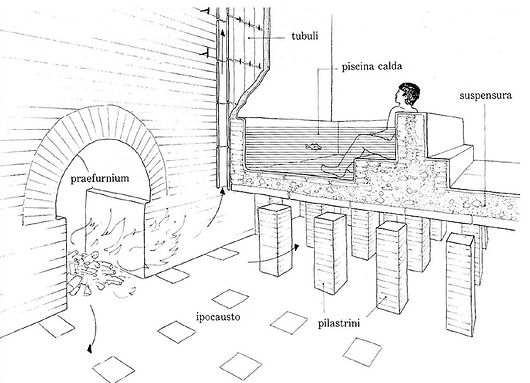
The hypocaust (hypocaustum, from Greek for “under-burnt”): Hot air from a furnace (praefurnium) flowed under suspended floors and often through wall flues (tubuli). Ancient writers (Pliny, etc.) credited the businessman Sergius Orata (~80 BC) with inventing “hanging baths” (pensiles balineae), but archaeology shows the technology predates him by decades or more; Orata likely refined and commercialized it (including for oyster beds and villas). Vitruvius describes the system in detail around 15 BC.
-
Development: By the late Republic and early Empire, baths included graded rooms—apodyterium (changing), frigidarium (cold), tepidarium (warm), caldarium (hot)—plus sweating rooms (laconica), exercise courts (palaestrae), and sometimes libraries or lecture halls. Large imperial thermae began with Agrippa’s baths in Rome (late 1st century BC) and reached spectacular scale under emperors such as Trajan, Caracalla, and Diocletian.
-
Social role: Accessible to most classes (often free or low-cost), bathing became a daily ritual combining hygiene, exercise, conversation, and status display. At the height of the Empire, there were hundreds of baths in Rome alone.
Spain (Hispania) and Continuity
Roman baths arrived early with colonization and military presence.
-
Early examples: Linked to colony foundations, such as around Valentia (Valencia, founded 138 BC) and Lugo (built ~15 BC near the city’s founding, using thermal springs).
-
Notable sites: Many across Tarraco, Emerita Augusta (Mérida), Italica, Segóbriga, and others. The Eastern Baths at La Alcudia (near Elche) form a large 2nd-century AD complex with an impressive swimming pool (natatio).
-
Alange (Badajoz, near Mérida): One of the most significant for continuous or near-continuous tradition. These medicinal thermal baths used natural warm water (~28°C). Structures (including two circular, domed chambers—one for men, one for women—with central pools) date to the 2nd–3rd centuries AD (in use under Trajan and Hadrian; a votive inscription confirms activity in the 3rd century). After periods of decline and abandonment, they were restored from the late 18th/early 19th century onward. The Roman chambers remain integrated into the modern spa (Balneario de Alange), making it one of the best-preserved and longest-used Roman thermal facilities in Spain. It forms part of the broader Mérida archaeological ensemble (UNESCO World Heritage).
-
Later: Visigothic and especially Islamic periods continued the tradition. Arab hammams (e.g., the 10th-century Baños Califales in Córdoba under al-Hakam II) adapted Roman hypocaust technology for steam and sequential hot/warm/cold rooms. Many Spanish place names (Caldas, Alhama) reflect thermal heritage.
Roman Heating Technology in Detail
The Romans developed the most sophisticated ancient systems for both room heating and hot water.
Hypocaust (underfloor and wall heating): A furnace (praefurnium) burned wood (or sometimes charcoal).
Hot air and smoke flowed into a void under a raised floor (suspensura) supported by stacks of brick pillars (pilae, typically spaced about 60 cm apart and often taller or reinforced near walls and under pools). The floor surface usually consisted of large tiles (bipedales), concrete, and a finished top layer (marble, mosaic, or tile).
Floors often sloped gently toward the furnace so heat circulated efficiently. Exhaust gases rose through vertical flues in the walls—early systems used tegulae mammatae (tiles with protruding knobs creating air channels); later and more common were tubuli (hollow rectangular clay pipes stacked against the walls).
These heated the walls by radiation and convection, then vented through the roof. In some cases, heating extended into vaults.
Studies of well-preserved sites (e.g., Indirizzo Baths in Catania) suggest hypocaust gas temperatures of roughly 90–125°C (sometimes higher near the furnace), producing comfortable room temperatures in the caldarium of about 30–40°C while avoiding dangerously hot surfaces. Large complexes required continuous firing; cooling a major bath could take days, so fires often ran day and night. Fuel demands were high—some provincial baths are estimated to have required the equivalent of a hectare of managed woodland per year.
Hot-water boilers and pool heating: The same furnaces usually heated water. Large bronze or lead cauldrons (boilers) sat directly over or beside the fire, often insulated by masonry. Vitruvius describes a practical three-boiler arrangement for double (men’s/women’s) baths: one for hot water, one for tepid, and one for cold, interconnected so that as hot water was drawn, tepid water replaced it and cold water topped up the tepid tank. Cold water typically came from aqueducts or cisterns via lead pipes and valves.
A specialized device called the testudo alvei (“turtle of the pool”) helped keep the water in the hot plunge pools (alvei) warm. This was a semi-cylindrical metal container (bronze or copper) open at one end to the pool bottom and positioned so its flat base sat directly in the furnace heat. Water circulated by convection: cooler water sank into the testudo, heated, and rose back into the pool. Evidence appears as early as the Stabian Baths in Pompeii; metal components were often later scavenged, so archaeological traces can be incomplete. Some pools also benefited from the radiant heat of the hypocaust floor beneath them.
Service areas for the stokers (often slaves) were practical and separated from the public spaces. Window glass, introduced more widely in the 1st century AD, improved lighting and heat retention in the hot rooms.
Greek and Early Systems
Greek public baths (balaneia) primarily used individual hip-baths with hot water poured over the bather. Heating was simpler—portable braziers, hot rocks, or small furnaces adjacent to the rooms. Some Hellenistic examples (3rd–2nd centuries BC in Sicily, southern Italy, and mainland Greece, such as Gortys and later phases at Olympia) show early channel or rudimentary underfloor heating that influenced Roman developments. Full Roman-style hypocausts and shared pools appear later in the Italian context.
Other Regions
-
Egypt: Private bathrooms with stone floors, drainage, and water-pouring arrangements exist from the Middle Kingdom onward in elite residences. Public baths of Greek (tholos/hip-bath) type arrived under the Ptolemies (Hellenistic period). Roman and Romano-Byzantine baths followed, with many well-preserved examples across the Nile Delta, oases, and sites such as Karnak, Trimithis, and Alexandria (including circular Ptolemaic public baths). Local adaptations persisted.
-
Near East and Mesopotamia: Pre-Hellenistic evidence is limited mainly to elite private bathtubs or simple pouring platforms. Public heated baths became more common after Greek and especially Roman influence. Later Byzantine and early Islamic baths (precursors to hammams) adapted hypocaust and steam techniques.
-
Elsewhere: Scythian-style sweat baths (felt tents with heated stones) are described by Herodotus. Pre-Islamic Iran had some public baths despite Zoroastrian concerns about polluting water; Sasanian rulers later promoted them. Chinese and Japanese thermal traditions focused more on natural hot springs, with constructed pools appearing by the Qin period in China.
